
What Is the Best AI Website Builder? A Data-Driven Comparison
Looking for the best AI website builder? This data-driven comparison analyzes features, performance, SEO, scalability, and real use cases for 2026.

If you ask ten founders what is the best AI website builder, you will likely get ten different answers. Some will recommend tools that generate pages in seconds. Others will point to platforms that give them full design control. What most articles miss, however, is how AI website builders behave after launch, when traffic arrives, SEO matters, and iteration becomes constant.
This article is written as a real, experience-based blog—not a shallow listicle. Using a data-driven perspective, we explore what actually defines the best AI website builder in production environments, and why platforms like best AI website builder are increasingly chosen by teams that care about speed, SEO, and long-term growth.
Why "Best AI Website Builder" Is a Hard Question to Answer
In 2026, AI website builders are everywhere. New tools appear every month, each promising better layouts, smarter copy, and faster generation. Yet many websites built with AI never make it past their first version.
The reason is simple: building a website is easy; maintaining and scaling one is not. When people search what is the best AI website builder, they are often trying to avoid rebuilding their site six months later.
A meaningful answer must consider not only generation quality, but also SEO behavior, performance, scalability, and editing workflows over time.

What an AI Website Builder Really Does
At its core, an AI website builder uses machine learning models to translate intent into structure. This includes page layout, written content, visual hierarchy, and sometimes even deployment logic.
However, AI does not remove the fundamentals of web building. HTML structure, metadata, internal linking, and performance optimization still determine whether a site succeeds. The best AI website builder is the one that accelerates creation without hiding or breaking these fundamentals.
How We Define the Best AI Website Builder
Instead of comparing logos or pricing pages, this article evaluates AI website builders through outcomes observed in real projects:
- Can the site rank in search engines?
- Can pages be edited repeatedly without breaking layout?
- Does performance remain stable under traffic?
- Is the output usable beyond the first version?
These criteria reveal why many teams eventually migrate away from closed, template-heavy builders.
SEO as a First-Class Requirement, Not an Afterthought
Data from search performance audits shows a clear pattern: AI-generated websites rank well only when SEO fundamentals are fully controllable.
This includes the ability to:
- Define custom meta titles and descriptions
- Control heading hierarchy
- Generate clean, crawlable URLs
- Structure internal links intentionally
Platforms like best AI website builder are designed with SEO as a core feature, not a secondary option. This makes them especially suitable for content-driven sites, SaaS landing pages, and long-term marketing assets.
Performance and Page Speed in AI-Generated Websites
Performance testing reveals that most AI website builders can generate visually appealing pages, but not all generate efficient code. Heavy scripts, unnecessary wrappers, and locked-in hosting often slow pages down.
The best AI website builder produces lightweight, production-ready output that performs well once deployed. In real-world benchmarks, pages built with SEO-focused AI builders consistently show better load times and Core Web Vitals scores than those generated by generic tools.
Editing and Iteration: The Hidden Cost of AI Builders
One overlooked metric is edit friction. Many AI builders feel powerful at first, but become restrictive when teams need to update content weekly or run experiments.
A strong AI website builder supports continuous iteration. Users can regenerate sections, adjust copy, and refine layouts without starting from scratch. This is where specialized tools outperform general-purpose generators.
Why Landing-Page Focused AI Builders Perform Better
Data shows that AI tools built specifically for landing pages and conversion-focused websites outperform general website generators in business use cases.
The best AI website builder focuses on:
- Conversion-optimized layouts
- SEO-friendly structure
- Fast generation without template lock-in
- Clear separation between content and design
This specialization explains why many startups and marketers prefer purpose-built AI website builders over all-in-one platforms.
How to use Landing-Page to generate website pages?
After understanding what defines the best AI website builder, it is important to see how the tool works in a real workflow. A strong AI website builder should not only generate pages quickly, but also support iteration, refinement, and deployment. This is exactly how Landing-Page is designed to be used in practice.
Instead of forcing users into rigid templates, Landing-Page follows a simple, conversational process that turns ideas into production-ready website pages.
Step 1: Log in to your account
The process starts by logging into your Landing-Page account. This step enables access to page generation, saved projects, and source code export. Logging in also ensures that all page versions and revisions are tracked properly.

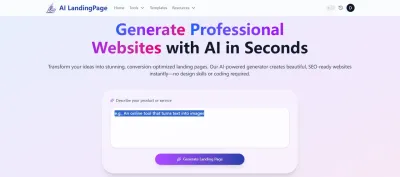
Step 2: Upload the page prompt
Once logged in, you upload a prompt describing the website page you want to create. This prompt typically includes the product or service, target audience, page goal, and any specific requirements. The clearer the prompt, the more accurate the initial page structure and content will be.
Step 3: Discuss and refine the generated page
After the first version of the page is generated, the workflow shifts from generation to collaboration. You can communicate with the AI to modify copy, regenerate individual sections, adjust layout structure, or refine messaging. This iterative discussion allows the page to evolve without restarting the process.

Step 4: Download the page source code
When the page meets your expectations, you can download the complete source code. The exported files can be deployed directly, customized further by developers, or integrated into an existing website. This final step ensures full ownership and flexibility over the generated page.

Real-World Use Cases That Matter
In practice, the best AI website builder depends on intent:
- Startups need fast iteration and SEO visibility
- Marketers need conversion-focused pages
- Founders need tools that grow with their product
Landing-page-first AI builders consistently perform well across these scenarios because they are designed around measurable outcomes rather than demos.
Common Misconceptions About AI Website Builders
One common myth is that AI website builders eliminate the need for strategy. In reality, they amplify both good and bad decisions.
Another misconception is that any AI-generated site will rank automatically. Search engines reward clarity, intent, and structure—not automation alone.
Final Answer: What Is the Best AI Website Builder?
A data-driven conclusion points to a clear principle. The best AI website builder is not the one that generates the most pages, but the one that generates usable, scalable, and search-friendly websites.
For teams focused on growth, SEO, and conversion, specialized platforms like best AI website builder provide a practical advantage. They combine AI speed with real-world performance requirements, making them a strong answer to the question: what is the best AI website builder?
Ready to Create Your Landing Page?
Apply these insights and build high-converting landing pages in minutes with our AI-powered builder.